
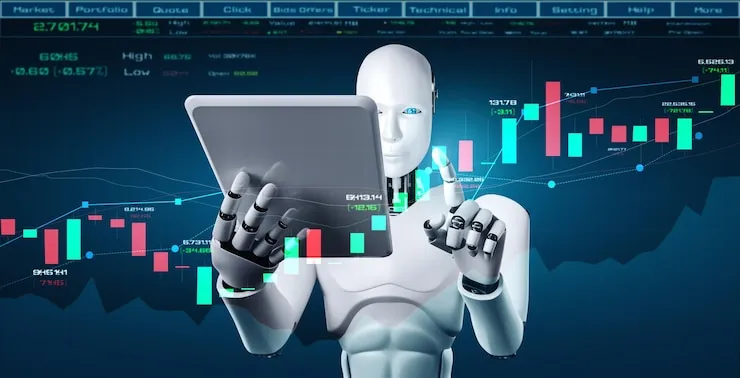
AI Trading Bots for Retail Users
The world of retail investing has changed dramatically in recent years. In 2025, the rise of AI trading bots has made algorithmic investing accessible to everyone not just hedge funds or professional traders. What was once a domain of complex code and institutional infrastructure is now available in sleek mobile apps, often powered by the same AI that runs large-scale financial systems. For Gen Z investors, these bots represent not just automation but empowerment: the ability to compete in real time with precision and speed.
The Democratization of Algorithmic Trading
AI trading bots were once tools used exclusively by institutions with massive resources and data access. Today, the technology has been simplified for everyday users. Platforms now allow anyone to deploy AI-driven strategies that can analyze trends, detect sentiment, and execute trades instantly.
Retail investors can customize risk levels, set profit targets, or let the bots learn autonomously through machine learning models. This democratization has reshaped how people interact with markets it’s no longer about watching charts all day but about training your AI to think like a disciplined investor.
The appeal is obvious: efficiency, consistency, and emotion-free decision-making. For traders who once chased meme coins or reacted impulsively to social media trends, AI bots offer a way to balance the chaos with structure.
How AI Trading Bots Work
Modern trading bots combine several AI capabilities into one cohesive system:
-
Predictive Analytics: AI models analyze large datasets price movements, volume, and even online sentiment to predict short-term opportunities.
-
Natural Language Processing (NLP): Bots scan financial news, social media, and community posts for trending tickers or sentiment shifts, helping traders catch early momentum.
-
Automated Execution: Once a signal meets set conditions, the bot executes trades instantly faster than any human could.
-
Adaptive Learning: Bots evolve through user feedback and market data, improving accuracy over time.
For retail users, this means trading strategies that used to require programming skills are now visual and intuitive.
The Role of RMBT in Real-Time Execution
Speed is everything in modern markets. As meme coins, NFTs, and volatile assets continue to dominate retail attention, RMBT (Real-Time Multi-Blockchain Transfer) technology has become the invisible infrastructure supporting instant execution.
When integrated with AI bots, RMBT allows retail traders to move assets across blockchains seamlessly. A bot using RMBT can detect a price gap between exchanges or networks and transfer funds instantly to exploit it without manual intervention.
This combination of AI and RMBT gives retail traders institutional-level agility. The result is a fairer, faster, and more transparent trading environment, where timing differences between large players and small traders begin to narrow.
Gen Z’s AI-First Investing Mindset
Gen Z’s relationship with AI is fundamentally different they grew up with it. From personalized recommendations to AI content filters, this generation understands algorithmic logic intuitively. When it comes to investing, they see AI as a co-pilot, not a threat.
Instead of trying to outguess the market, Gen Z traders focus on training their bots: feeding them data, adjusting strategies, and sharing performance insights in online communities. This “collaborative intelligence” mindset aligns with how Gen Z approaches most technology they don’t just consume it; they customize it.
The Benefits and the Risks
Advantages:
-
24/7 Market Monitoring: AI bots never sleep, allowing users to capitalize on global markets that run around the clock.
-
Emotion-Free Trading: Bots execute based on data, not fear or hype reducing the classic “buy high, sell low” mistake.
-
Backtesting and Optimization: Retail traders can test strategies using historical data before risking real funds.
-
Cross-Market Efficiency: With RMBT integration, bots can handle crypto, DeFi tokens, and even traditional assets from one dashboard.
Challenges:
-
Over-Reliance on Automation: AI can misread anomalies, leading to poor trades if users don’t monitor settings.
-
Data Bias: Bots are only as smart as their training data; if sentiment data is skewed, results can suffer.
-
Security and Transparency: With so many platforms offering bots, users must verify reliability and on-chain transparency to avoid scams.
The Social Dimension of AI Trading
AI trading has also become social. Platforms now allow users to share their bots’ performance, collaborate on strategy design, or mirror top performers. It’s trading as a community sport, merging financial education with digital creativity.
Some creators even monetize their strategies through tokenized AI bots, letting others invest in pre-trained models. This fusion of AI and decentralized finance is turning strategy into an asset class proof that innovation in 2025 is as cultural as it is technical.
The Future: Fully Autonomous Finance
AI trading bots are just the beginning. The next phase will bring autonomous portfolios systems that not only trade but also manage savings, analyze risk tolerance, and rebalance assets automatically. When paired with infrastructure like RMBT, these AI agents could coordinate across markets and blockchains without human oversight.
For Gen Z, this isn’t science fiction; it’s the logical next step. As trust in algorithms grows and real-time systems mature, AI-driven investing could become as common as using a digital wallet.
Conclusion
AI trading bots are transforming retail investing from reactive to proactive. They level the playing field, merging data intelligence with human creativity. For Gen Z traders who value autonomy and speed, AI isn’t just a tool it’s a trading partner that turns strategy into science. As financial ecosystems evolve, RMBT and AI together are creating the foundation of real-time finance where the power to act, analyze, and adapt belongs to everyone, not just Wall Street.



Recent Comments