
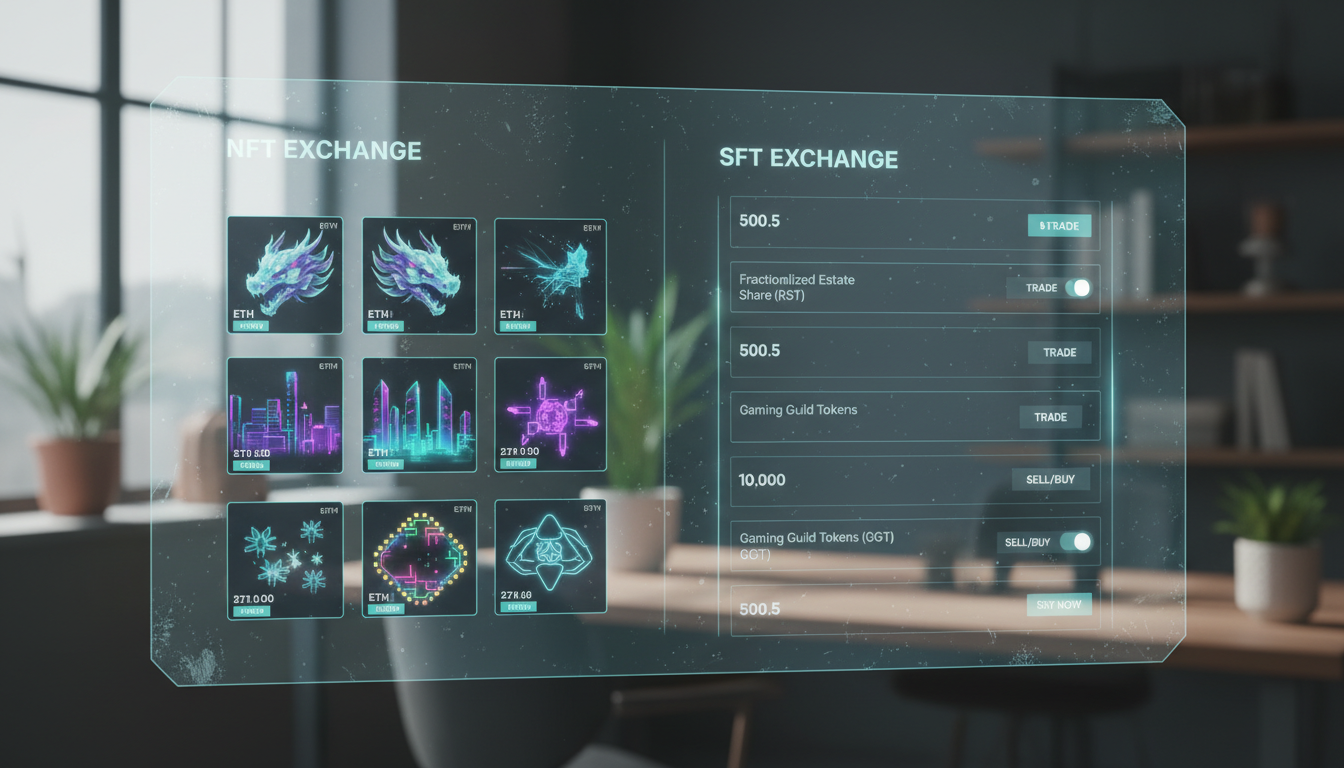
Breaking Down Non-Fungible Tokens
Market desks are treating token design as a real catalyst Today, because pricing and custody tools now react to contract standards, not just hype. Traders watching creator royalties, marketplace fees, and chain congestion are shifting listings between networks in Live conditions. Developers point to the Ethereum community standard ERC-721, maintained on GitHub by the Ethereum Improvement Proposals process, as the baseline for uniqueness and provenance, and this is where NFTs vs SFTs becomes a practical question for issuance and compliance rather than a debate about collectibles. The latest Update from several marketplaces has focused on clearer metadata handling and stricter collection verification, which can reduce confusion in secondary trading.
Exploring Semi-Fungible Tokens
Semi-fungible tokens are getting renewed attention Today as game studios and ticketing pilots seek items that start interchangeable, then become unique after redemption. Under Live testing, many teams implement SFT behavior with the ERC-1155 multi token standard, which the Ethereum Foundation documents as a way to manage multiple token types in one contract, and coverage of operational risk has also sharpened with JPG Store shutdown deadline details highlighting how user inventories depend on platform continuity and self custody habits. For readers tracking adjacent policy and platform news, UK Supreme Court Backs Government in Legacy Case has been circulating in tech circles as a reminder that legal context can shift quickly, including via UK Supreme Court Backs Government in Legacy Case. Another Update from builders is improved batch transfers for high volume drops.
Comparing NFTs vs SFTs Core Differences
When teams talk about token differences in 2026, they are usually describing how supply, transfer rules, and metadata mutation affect market behavior under stress. In Live deployments, an NFT stays singular by design, while an SFT can represent many identical units until a state change makes a unit distinct, such as a ticket being used. On the analytics side, the internal explainer NFTs explained, context and market players tracks how marketplaces classify collections, which influences discovery and liquidity, and that practical split keeps NFTs vs SFTs a product choice for redemption workflows and inventory accounting. Today, exchanges and wallets are also standardizing display rules so end users see clearer token names and images. A continuing Update from auditors is to flag contracts where metadata can be altered without disclosure.
Practical Applications of NFTs and SFTs
Across digital assets desks, the near term focus is on utilitarian minting, not profile picture cycles, because brands want measurable redemption and customer service outcomes. In Live pilots, SFTs are being used for event access where identical passes are sold, then each becomes unique once scanned, enabling post event perks without issuing a second asset. For macro sensitive traders, FOMC Today and NFT floor price context has been used to frame how risk on, risk off flows can hit illiquid collections, including via FOMC Today and NFT floor price context. NFTs remain dominant for one of one art, membership credentials, and high value provenance trails, where collectors demand clear uniqueness at purchase. Another Update in marketplaces is tighter spam filtering for airdropped tokens that mimic real listings.
Future Trends in Token Utilization
The next wave is likely to be driven by crypto tokens that behave more like receipts, with programmable compliance hooks and clearer lifecycle states that regulators can interpret. In Live infrastructure roadmaps, wallets are adding richer token previews and warnings when approvals are broad, which reduces accidental transfers and improves user confidence. Builders watching NFTs vs SFTs also expect more hybrid deployments where an SFT handles distribution, then converts into an NFT for long term ownership once a condition is met, such as a product shipment or identity check. Today, market structure conversations are centered on custody, portability, and durable metadata, because those factors decide whether a token survives platform churn. A continuing Update from standards bodies and auditors is pushing for transparent upgrade patterns so buyers can see if a contract can change after minting.



Recent Comments